
Rapid Degaussing for Highly Sensitive Magnetometers: A Case Study of the Kiel Magnetically Shielded Room (KMSR)
Workshop Biosignals 2026, 25–27 February 2026, Innsbruck, Austria.
DOI: 10.15203/99106-194-6-13Kiel University · Core Facility
The Kiel Magnetically Shielded Room (KMSR) at Kiel University provides a controlled environment for investigating weak magnetic signals. By suppressing the Earth’s magnetic field and external magnetic disturbances, it supports magnetometry and biomagnetic measurements.
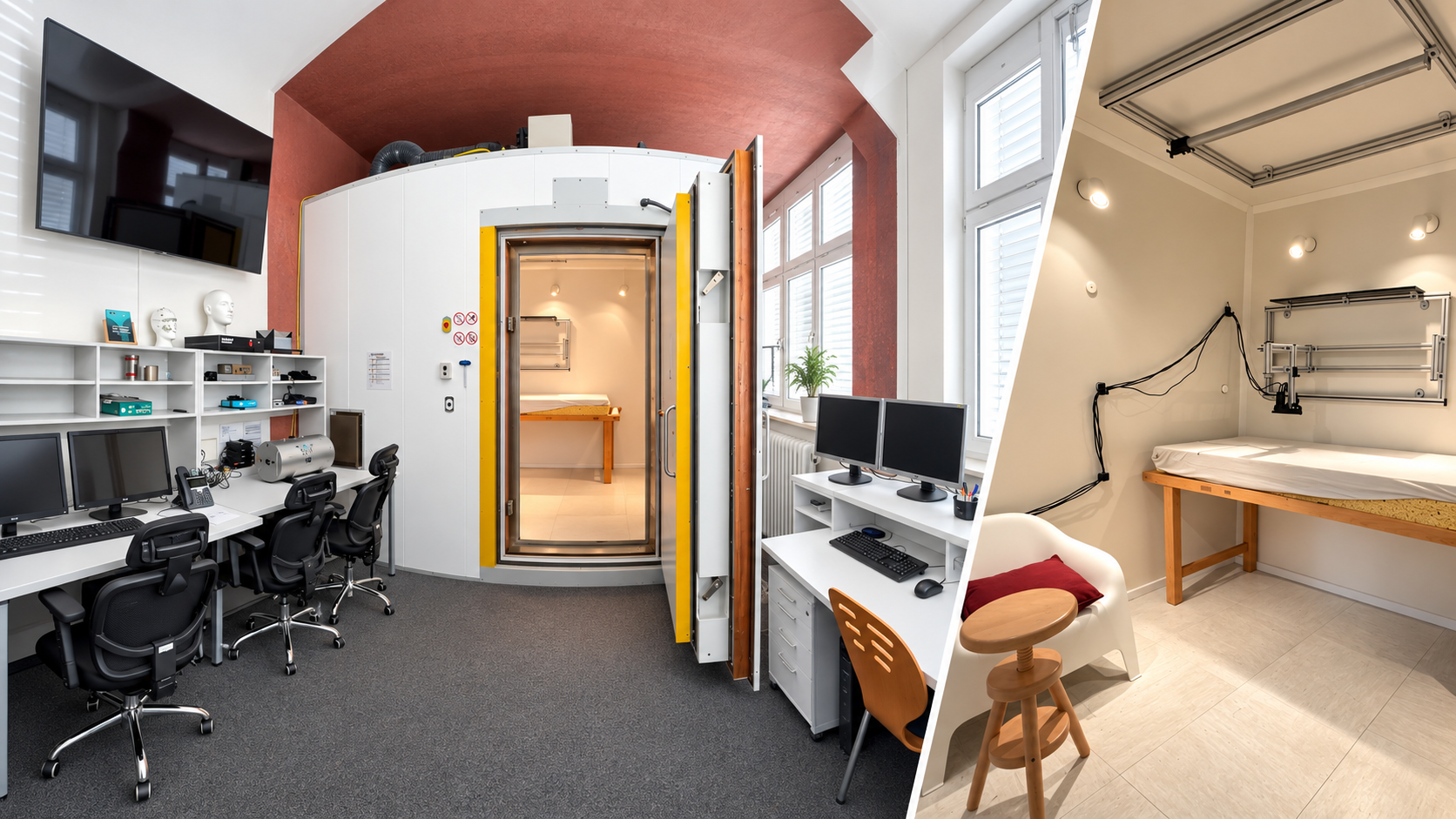
The room’s passive shielding consists of three nested layers of high-permeability mu-metal, which guide magnetic flux around the measurement volume. The frequency-dependent shielding factor reaches approximately 200 (46 dB) at 0.01 Hz and 10,000 (80 dB) at 6 Hz, attenuating environmental interference across frequencies relevant to biomagnetic research.
Beyond shielding external disturbances, careful magnetic conditioning of the room is essential for achieving low residual fields. Following an optimized degaussing procedure, measurements yielded residual magnetic fields of approximately 0.3 nT at the room center. Within the central measurement volume of 1 m³, the field map exhibits a maximum of approximately 6 nT near the door. These values characterize the measured post-degaussing state within the investigated volume.
Drag to rotate. Use the toolbar to zoom, or select Reset view to return to the initial angle.
The facility accommodates magnetic sensors, including optically pumped magnetometers (OPMs), and supports the characterization of magnetic measurement systems, OPM-MEG, and the development of biomagnetic measurement methods.
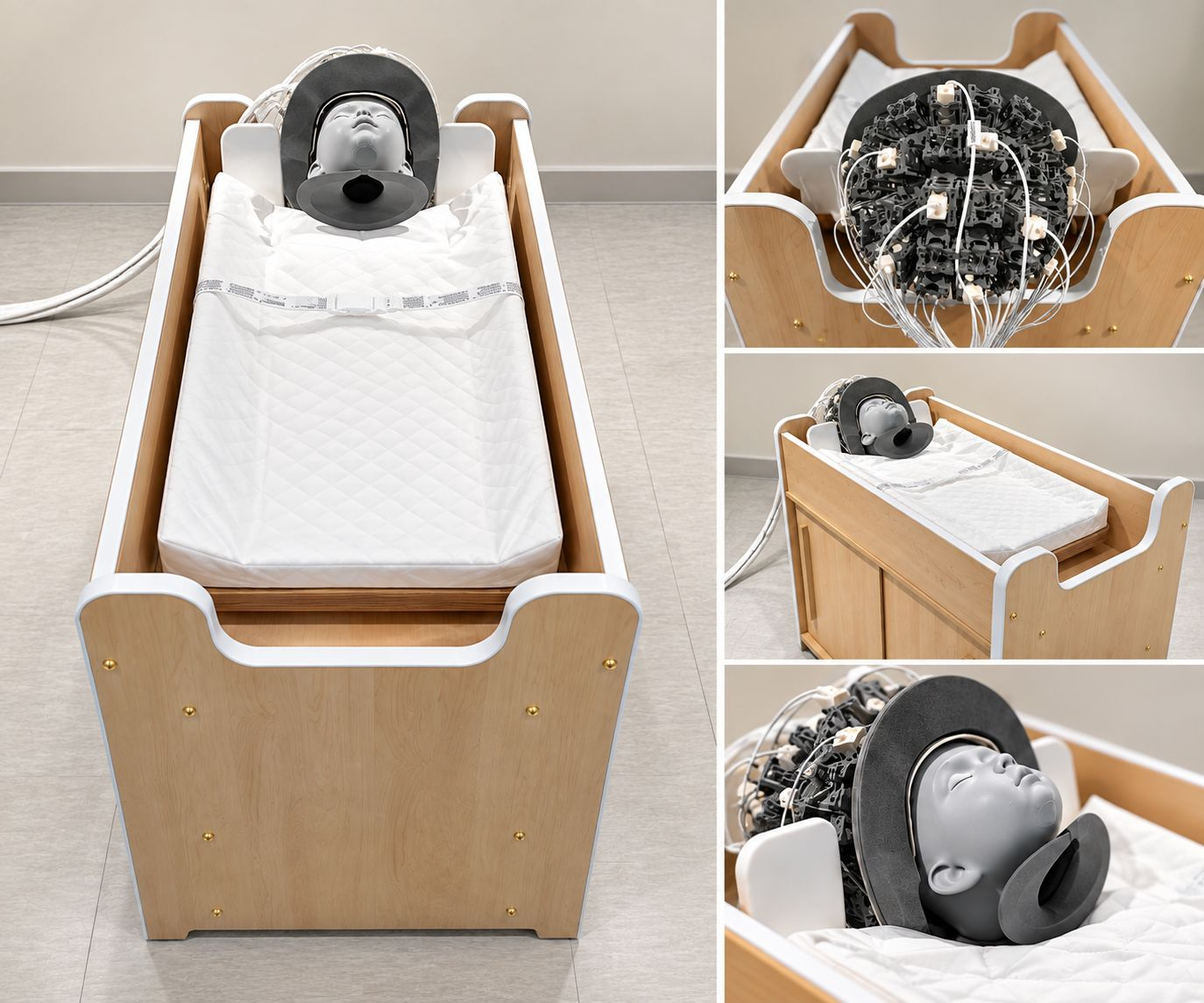
The KMSR houses a FieldLine HEDscan OPM-MEG system with 25 optically pumped magnetometers for biomagnetic measurements and methodological research. A dedicated infant bed with a fixed sensor helmet enables controlled measurements in the supine position and provides a platform for investigating infant OPM-MEG.
Further details on the degaussing procedure and residual-field characterization are provided in the following open-access contribution:
Workshop Biosignals 2026, 25–27 February 2026, Innsbruck, Austria.
DOI: 10.15203/99106-194-6-13